
AI Visibility Scorecard
20 questions about your brand and website. Answer honestly; “not sure” is a useful answer too. You’ll get a score out of 100 and your biggest gap.
Have your website and your LinkedIn company page open in another tab. It helps.
Your AI visibility score
Your first three fixes
Your full action plan
Want the whole method? The AI Search Visibility Playbook walks through every fix above, with the six templates I use to audit and track brands.
See the playbookWhat the scorecard measures
The AI Visibility Scorecard checks the four things that decide whether AI assistants like ChatGPT, Perplexity, Gemini and Google AI Overviews mention your brand. Each lever gets five questions and a score out of 10; together they make your score out of 100.
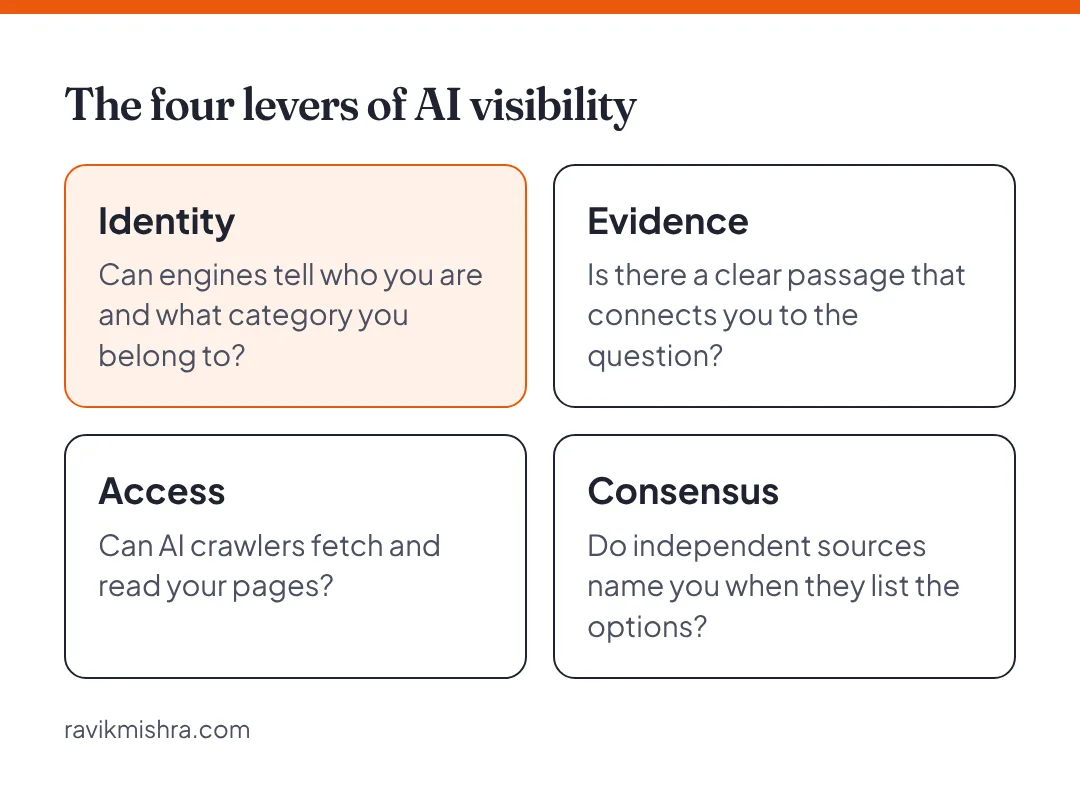
- Identity: whether engines can tell who you are, from consistent facts, a clear About page and Organization schema.
- Evidence: whether your pages answer buyer questions directly, with prices, comparisons and original data.
- Access: whether AI crawlers can fetch and read your pages, through robots.txt, CDN settings and rendering.
- Consensus: whether review sites, articles and communities name you when they list options.
Questions
Is the AI Visibility Scorecard free?
Yes. You see your score, your weakest lever and your first three fixes on screen without signing up. Your full action plan is emailed to you if you ask for it.
Does the scorecard query ChatGPT or other AI tools?
No. It is a self-assessment based on 20 questions about your brand and website, so it works instantly and nothing about your brand is sent to an AI service.
What is a good AI visibility score?
Below 40 usually means AI engines have little to go on. Between 40 and 69 means you are visible in places but have gaps competitors can use. 70 or more is a strong foundation, where the remaining gains come from consensus and tracking.
Who built it?
The scorecard was built by Ravi Kumar Mishra, an SEO leader with 18 years of experience, from the audit method in The AI Search Visibility Playbook.