

AI assistants cite passages that answer a question directly, specifically and verifiably. Put a buyer’s question in a heading, answer it in the first one or two sentences, support it with a table or concrete detail, and add something only you can say. Then build the page types engines reach for most: comparisons, pricing, category guides and original research.
The passage pattern
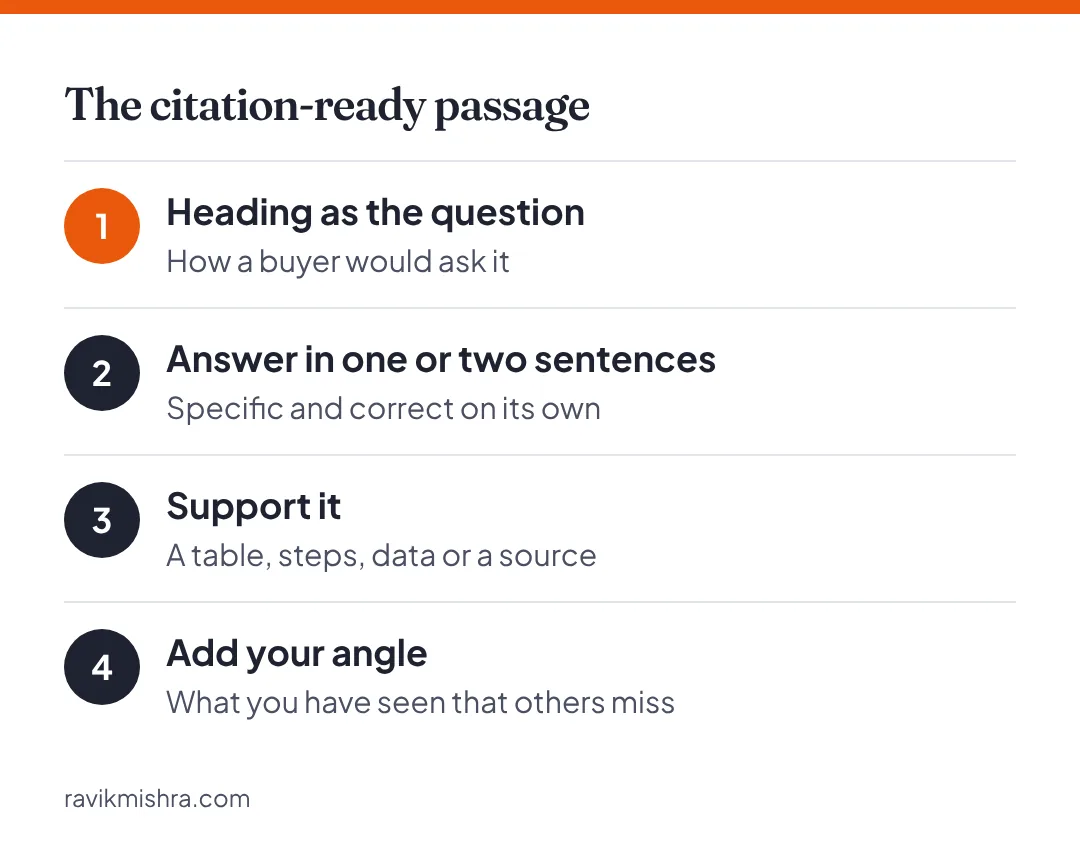
Every section of a citation-ready page follows the same four steps:
- Heading as the question. Close to how a buyer would ask it: “How much does payroll software cost in India?”
- Direct answer. One or two sentences: “Most payroll software for small Indian businesses costs ₹50 to ₹150 per employee per month. Plans that include compliance filing sit at the higher end.”
- Support. A table, the factors that change the answer, an example, a source.
- Your angle. What you’ve seen, what people get wrong, when the answer changes.
Then test it. Read the answer sentence alone. If an assistant quoted only that sentence, would it be correct and useful? If yes, the section is ready.
Specific beats general
Compare these:
| Vague | Specific |
|---|---|
| Invoicing takes up a lot of agencies’ time. | Most small agencies spend several hours a week on invoicing and chasing payments. |
| Our tool is affordable. | Plans start at ₹999 a month for up to five users. |
| Setup is quick. | Most teams import their clients and send a first invoice on day one. |
Numbers, names, dates and prices give an assistant something to say. Adjectives don’t.
The page types worth building
Look at the pages AI assistants cite for your category today. They usually fall into a few types:
- Comparison pages: “[you] vs [competitor]” and “[competitor] alternatives”. Be fair. A table of real differences beats a page of claims.
- Pricing and specification pages: plain, current facts. Assistants answer pricing questions constantly and guess when they can’t find the answer.
- Category guides: what the category is, how to choose, and the main options, including competitors.
- Best-of lists for a niche: “best [category] for [specific audience]”, with open disclosure if you include yourself.
- Original research: a survey, benchmark or dataset nobody else has. This gives every answer on the topic a reason to cite you.
- How-to guides: step-by-step answers to the problems your product solves.
Habits that block citations
- Long introductions before the first answer
- Prices and key facts hidden behind forms
- No author, no date
- Mass-produced text that says what every other page says
- Outdated numbers on pages that still rank
Refresh before you write
Before creating new pages, look at what you already have. Pages that rank for the topic but bury the answer are your fastest wins. Move the answer up, add a table, add the author and date, update the numbers. It’s often a one-hour job per page, and it tends to show results sooner than a new page.
Frequently asked questions
How long should a citation-ready page be?
As long as it takes to answer the question and its obvious follow-ups. Each section should start with its answer.
Does AI-written content get cited?
Pages that only repeat what other pages say give engines no reason to cite them. Original data, examples and expert opinion do.
Should I update old pages or write new ones?
Refresh pages that already rank for the topic first. Moving the answer to the top is often a one-hour job.