

GEO (generative engine optimization), AEO (answer engine optimization) and LLMO are all names for the same goal: getting your brand mentioned and cited in AI-generated answers. Most of it builds directly on SEO. What changes is the unit of success, which shifts from a ranked link to a mention inside an answer, and the weight given to consistency and independent agreement.
The names
You’ll see several terms used almost interchangeably:
- GEO: generative engine optimization, from a 2023 research paper on improving visibility in AI-generated responses
- AEO: answer engine optimization, an older term from the featured-snippet and voice-search era, now applied to AI answers
- LLMO / AI SEO / AI visibility: looser labels for the same work
The label matters less than the method. I use “AI search visibility” because it describes the outcome.
What carries over from SEO
| SEO practice | Why it still matters |
|---|---|
| Crawlability and indexing | AI engines read Google’s and Bing’s results, and their own crawlers need access |
| Helpful, specific content | Retrieval picks passages that actually answer the question |
| Authority and links | Sources that rank well are more likely to be retrieved and trusted |
| Structured data | Removes ambiguity about who and what a page is about |
| Technical performance | Pages that fail to load or render can’t be read |
If your SEO foundation is weak, fix that first. It’s the cheapest route into many AI answers.
What’s genuinely different
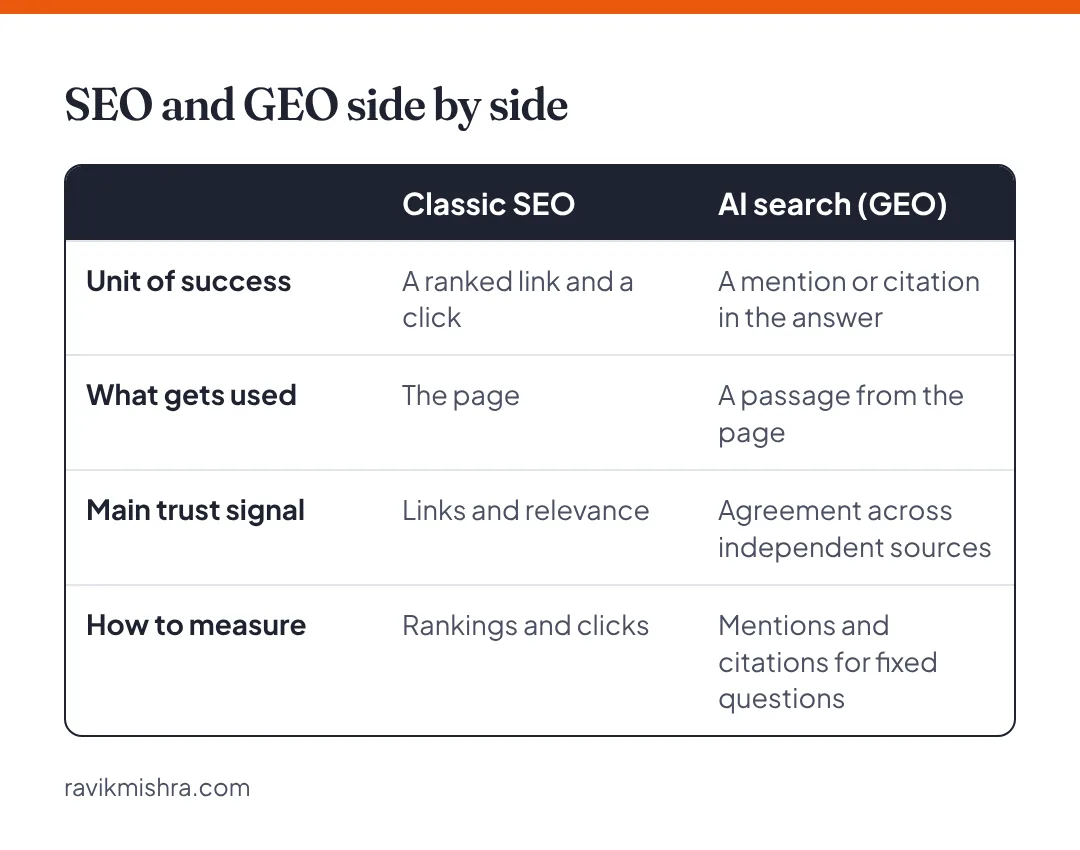
The unit of success. In classic search you win a position and hope for a click. In AI search you win a mention, often without a click. Measurement has to change accordingly: track mentions and citations directly, not just traffic.
Passages over pages. Engines lift the paragraph or table that answers the question. A page that buries its answer loses to a weaker page that leads with it.
Consensus over claims. When an assistant lists the best options, it leans heavily on what independent sources agree on. Your own page saying you’re the best does little. Review sites, comparison articles and community discussion do a lot.
Entity clarity. Inconsistent facts about your brand across the web make engines hedge. Consistency is worth more than it used to be (entity SEO for AI search).
Crawler policy. There are now several AI crawlers with different jobs. Blocking the wrong one removes you from live answers.
Where to spend effort
For most brands the order is: fix technical access, make your brand facts consistent, restructure your best pages so they answer directly, then work on the off-site sources engines already cite. Measure all of it with a fixed set of buyer questions checked every week, as in this tracking routine.
Frequently asked questions
Is GEO replacing SEO?
No. GEO builds on SEO. Crawlability, helpful content and authority still matter, and AI engines often read search results.
What is the difference between GEO and AEO?
They are different names for the same goal, getting mentioned and cited in AI-generated answers. AEO is the older term from the featured-snippet era.
Where should I start with GEO?
Fix technical access, make your brand facts consistent, restructure your best pages to answer directly, then work on the sources engines already cite.