

Google AI Overviews draw on Google’s normal search index, so the foundation is ordinary SEO: your page has to be indexed and eligible to show a snippet. On top of that, pages that answer the question directly, in a passage that can stand on its own, are the ones most often linked.
What Google has said
Google’s guidance for site owners is that there are no special requirements for AI features like AI Overviews and AI Mode. To be eligible as a supporting link, a page must be indexed and eligible to be shown in Search with a snippet. The usual best practices apply: helpful content, crawlable pages, good page experience.
Two practical consequences:
- If you block snippets with
nosnippetor limit them heavily withmax-snippet, you also limit how your content can appear in AI features. - You don’t need a separate “AI Overview” file, tag or markup.
What tends to get cited
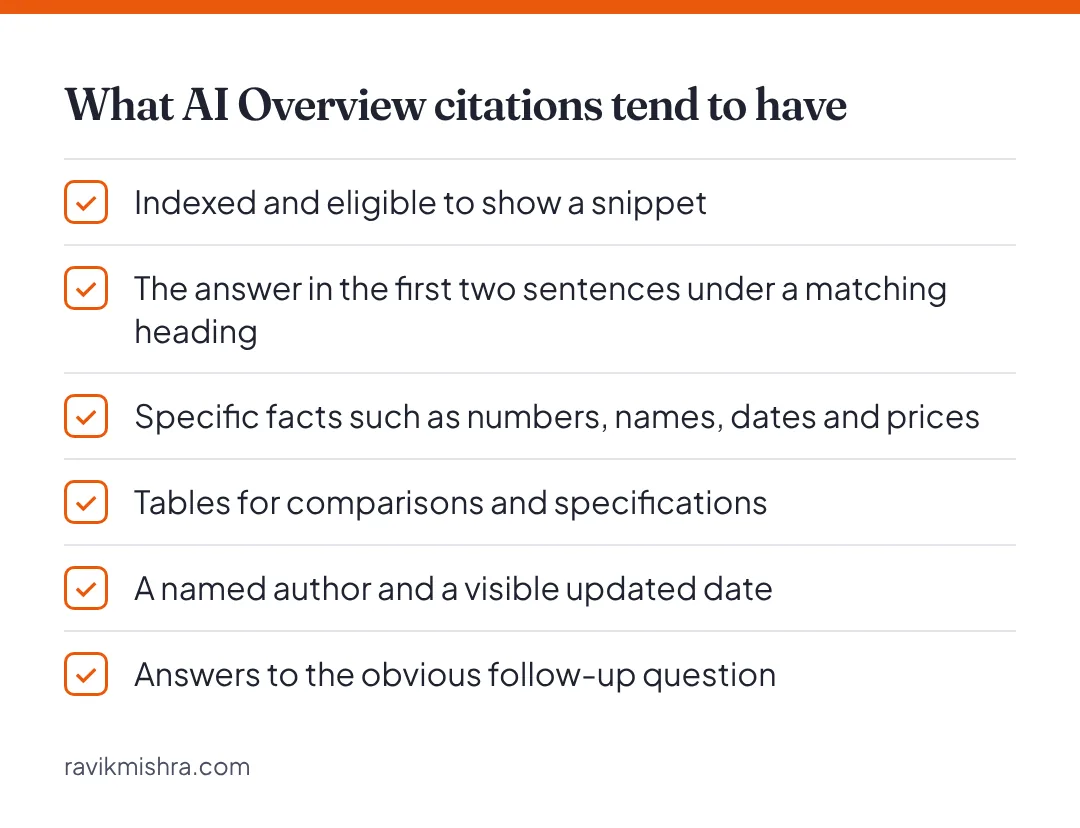
Google doesn’t publish a recipe beyond that, but looking at which pages get linked for a set of questions shows consistent patterns:
| Trait | Why it helps |
|---|---|
| Answer in the first two sentences under a matching heading | The overview needs a passage it can summarise accurately |
| Specific facts: numbers, names, dates, prices | Vague claims give the summary nothing to use |
| Tables for comparisons and specifications | Structured comparisons are easy to extract correctly |
| Clear authorship and a visible updated date | Helps signal that the information is current and accountable |
| Covers the follow-up questions too | Overviews often answer several related questions at once |
A practical process
- List the questions. Take 20 to 30 questions your buyers search, and note which ones show an AI Overview today.
- Record the current sources. For each overview, note which pages are linked. Are any yours?
- Find near-misses. Pages that rank on page one but aren’t linked in the overview are your fastest wins.
- Restructure those pages. Move the answer to the top, add a comparison table if relevant, add the author and date, and cover the obvious follow-up question.
- Recheck in two to four weeks. Overviews change often, so look at the trend over several checks rather than one.
Don’t chase every query
Many queries never show an AI Overview, and the ones that do change frequently. Focus on questions that matter commercially. A citation for “best [category] for [audience]” is worth far more than one for a definition nobody buys from.
Measuring it
Search Console includes AI Overview and AI Mode traffic within your normal Search performance data rather than as a separate line, so you can’t isolate it cleanly there. A simple weekly log of your target questions, recording whether an overview appears and whether you’re linked, is still the most reliable way to track progress (how to set one up).
Frequently asked questions
Do I need special markup to appear in AI Overviews?
No. Google says there are no special requirements. A page must be indexed and eligible to be shown in Search with a snippet.
Can I opt out of AI Overviews?
Snippet controls such as nosnippet and max-snippet limit how your content appears in AI features too, but they also limit your normal search snippets.
Can I see AI Overview traffic in Search Console?
It is included in your normal Search performance data rather than reported as a separate line, so a weekly log of target questions is still the clearest way to track citations.