

ChatGPT names a brand when it’s confident who the brand is, finds a clear passage linking it to the question, can read the pages that say so, and sees other independent sources agreeing. If any one of those four is missing, you tend to be left out, even when you rank well on Google.
This guide walks through each one and what to do about it.
Why ChatGPT recommends some brands and not others
ChatGPT can answer in two ways. Without web search, it relies on what the model learned in training: which brands appeared often, consistently and positively alongside your category across the web. With search on, which is now the default for most recommendation questions, it runs searches, reads a handful of pages, and writes an answer from them.
Both paths reward the same underlying things. The difference is speed. Changes to live search results can show up in weeks. Changes to what the model “knows” show up when new model versions are trained, which takes much longer.
The four levers
| Lever | The question it answers | Typical fix |
|---|---|---|
| Identity | Does ChatGPT know who you are and what category you’re in? | Consistent descriptions everywhere, clear About page, Organization schema |
| Evidence | Is there a passage that connects you to this question? | Pages that answer buyer questions in their first two sentences |
| Access | Can OpenAI’s crawlers fetch and read those pages? | Allow OAI-SearchBot, check CDN bot rules, render content without JavaScript |
| Consensus | Do other sites name you when they list options? | Review sites, “best of” articles, honest community participation |
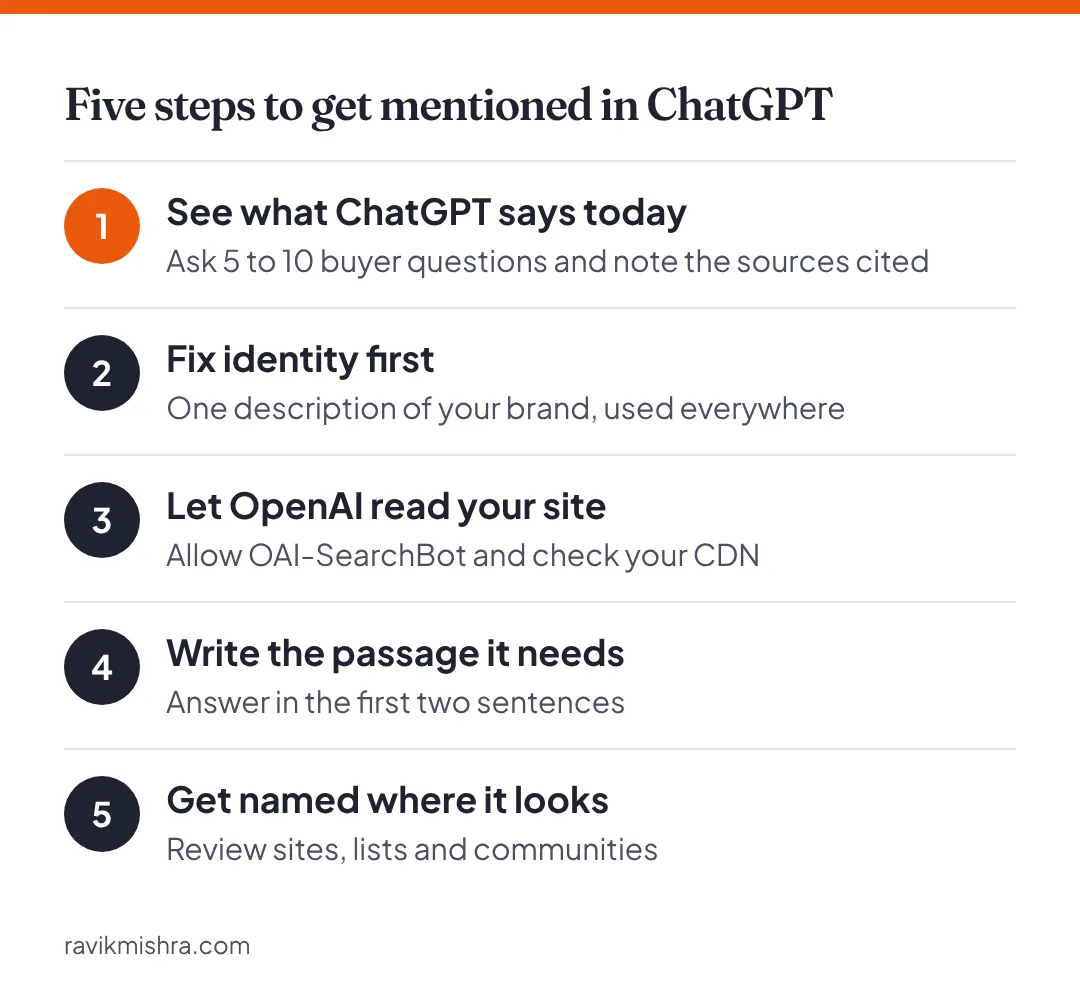
Step 1: See what ChatGPT says today
Before changing anything, ask ChatGPT (with search on) five to ten questions a buyer would ask. Include category questions (“best [category] for [audience]”), comparisons (“[you] vs [competitor]”) and brand questions (“what is [you]?”, “how much does [you] cost?”).
For each answer, note three things: whether you’re named, who else is named, and which websites are cited. The cited websites are the most useful data you’ll collect. They show you which sources ChatGPT trusts for your category.
Step 2: Fix identity first
If ChatGPT gets basic facts about you wrong, or describes you vaguely, fix that before anything else. It usually means the web tells inconsistent stories about you. The entity SEO guide covers the fix in full.
- Write one plain sentence that says what you do and who it’s for.
- Use those exact words on your About page, LinkedIn, Google Business Profile and directory listings.
- Add Organization schema to your homepage with
sameAslinks to every official profile. - Correct outdated facts on third-party pages that still rank.
Step 3: Check that OpenAI can read your site
OpenAI uses different crawlers for different jobs. OAI-SearchBot fetches pages for ChatGPT’s search results. ChatGPT-User visits pages when a user’s request triggers it. GPTBot collects content for training.
Blocking GPTBot doesn’t remove you from ChatGPT search. Blocking OAI-SearchBot does. Check your robots.txt (which crawlers to allow), and check whether your CDN or firewall is blocking these crawlers silently. That second check catches a lot of sites.
Step 4: Write the passage ChatGPT is looking for
When ChatGPT searches, it reads passages rather than whole pages. For each important buyer question, you want a page where:
- a heading matches the question,
- the first one or two sentences answer it directly and specifically,
- a table, list or example supports the answer,
- a named author and an updated date make it verifiable.
Comparison pages, pricing pages and honest category guides (how to write them) are the page types that most often get cited for commercial questions.
Step 5: Get named where ChatGPT looks for agreement
Go back to the cited websites from step 1. If the same review platforms and articles keep appearing, those are your targets. Get your profiles complete and reviewed, and give article authors a reason to include you.
This is the slowest lever and the most valuable. It’s also the one where shortcuts backfire: fake reviews and undisclosed forum posts get removed and can damage trust in the places ChatGPT reads most.
How long it takes
Accuracy about your brand usually improves first, once facts are consistent and crawlers can get in. New citations follow as pages are indexed and picked up. Category mentions move last, as independent sources start naming you. Track the same set of questions every week so you can see which stage you’re in. Here’s a simple weekly routine.
Frequently asked questions
Can I pay to be recommended by ChatGPT?
No. ChatGPT’s answers aren’t sold as placements. Visibility comes from being clearly identified, citable and named by independent sources.
Does blocking GPTBot remove my site from ChatGPT search?
No. GPTBot collects training data. OAI-SearchBot is the crawler that fetches pages for ChatGPT’s search results, so that is the one to allow.
How long before ChatGPT starts mentioning my brand?
Accurate descriptions of your brand usually improve within weeks of fixing inconsistent facts and crawler access. Being named for category questions takes longer, because it depends on other sites mentioning you.