

Track AI visibility the way you’d track rankings: a fixed set of buyer questions, checked in the same engines every week, with the results logged. Three numbers are worth reporting: how often you’re mentioned, your share of mentions against competitors, and how often your pages are cited.
Why your normal reports miss it
Rank trackers measure positions in a list of links. Analytics measures clicks. AI answers often name a brand without sending a click, and a buyer who reads “the main options are A, B and C” may search for A directly a week later. None of that shows up as AI traffic.
So you need a direct measure: ask the engines the questions your buyers ask, and record what they say.
Step 1: Build a fixed prompt set
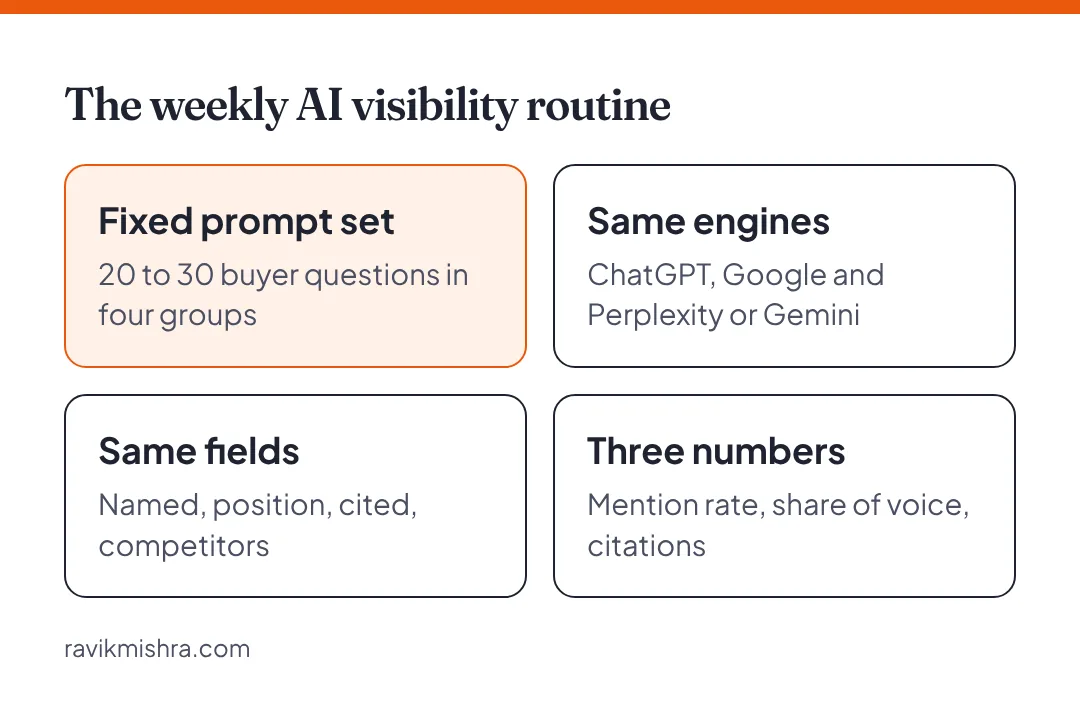
Write 20 to 30 questions in four groups:
| Group | Example |
|---|---|
| Category | best project management software for design agencies |
| Problem | how do I stop missing client deadlines in a 15-person agency |
| Comparison | Asana vs Monday for a design agency |
| Brand | is [your brand] good for agencies? |
Write them the way people talk to an assistant: longer, with context like team size, location and budget. Your sales team’s call notes are the best source.
Once you start tracking, don’t reword the questions. Add new ones if you need to, but changing existing wording breaks the trend.
Step 2: Pick your engines
Start with the three that matter most to your buyers. For most businesses that’s ChatGPT with search, Google (AI Overviews), and Perplexity or Gemini. Add Copilot if your buyers live in Microsoft tools.
Use a fresh or logged-out session where you can, since chat history and personalisation change answers.
Step 3: Log the same fields every week
For each question and engine, record:
- Named: yes or no
- Position: first, top three, or lower
- Cited: is one of your pages linked?
- Competitors named: which ones
Answers vary between runs, so for your five most important questions, run each one three times and record how many times you appear.
Step 4: Report three numbers
- Mention rate. The share of questions where you’re named, per engine.
- Share of voice. Your mentions divided by all mentions of you and your main competitors.
- Citations. How many answers link to your pages.
Add one before-and-after screenshot each month. It persuades more than any chart.
When to use a paid tool
Manual tracking works well up to about 50 questions. Beyond that, or across several brands, paid AI visibility trackers save real time. Start manually anyway for the first two months. Reading the answers yourself teaches you more about why you’re missing than any dashboard.
Frequently asked questions
How many prompts should I track?
Twenty to thirty is enough to start. Keep the wording fixed once you begin so the trend stays comparable.
Why do AI answers change between runs?
AI assistants generate each answer fresh, so results vary. Run your most important questions three times and record how often you appear.
When is a paid AI visibility tool worth it?
Once you track more than about 50 prompts or several brands. Start manually for the first two months to learn why you are missing.